
How Students Choose Colleges in the Age of AI Search
The college search now starts with a question, not a click
A growing share of prospective students form their first impression of your institution inside an AI answer, before they ever reach your website. They ask ChatGPT, Gemini or Google's AI Overviews to recommend programs, compare finalists, estimate cost and project salaries. Then they act on what comes back.
That changes the job of higher education marketing. Ranking on page one still matters, but it is no longer enough. Your institution now also has to be the source the AI trusts, quotes and gets right.
This guide covers what the latest research says, how to see what AI is telling students about you, and the specific fixes that move the needle on enrollment.
What the 2026 research says
AI use in the college search nearly doubled in a single admissions cycle. EAB's survey of more than 5,000 high school students, fielded in fall 2025, found 46% now use tools like ChatGPT in their search, up from 26% in spring 2025. Nearly one in five (18%) dropped a college from consideration based on something an AI result told them. (EAB)
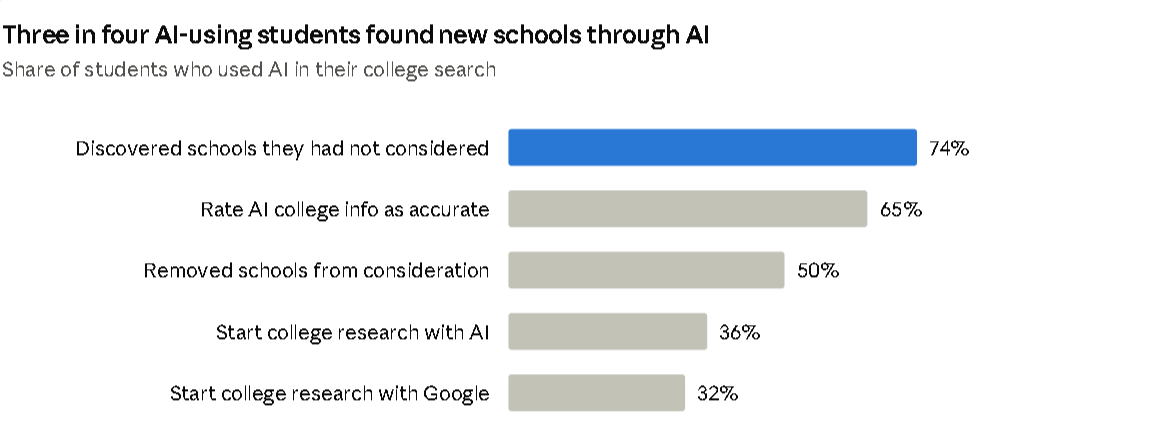
OHO's March 2026 survey shows what that looks like among students actively researching college. AI and Google are now essentially tied as the first place they go, and AI is reshaping who makes the list.
What this means for your organic traffic
Fewer searches send anyone to a website at all. SparkToro found 68% of U.S. Google searches ended without a click in early 2026. (Search Engine Land)
When an AI Overview appears, the top result loses most of its clicks. Ahrefs measured a 58% drop in click-through rate for position-one pages on queries with an AI Overview, based on 300,000 keywords. Pew's panel study found users clicked an organic result 8% of the time with an AI Overview versus 15% without one. (PPC Land, Relevant Audience)
For colleges, the hardest-hit queries are the informational ones that used to fill the top of the funnel: "what can you do with a psychology degree," "is an MBA worth it," "how much does a nursing program cost." Branded and high-intent searches hold up better.
The practical takeaway: your goal shifts from winning the click to winning the citation. A program page that AI quotes accurately is doing recruiting work, even when Google Analytics never sees the visit.
Step one: audit what AI says about you
You can run a useful first audit in an afternoon. Open ChatGPT, Gemini, Perplexity and Google (to trigger AI Overviews), use a logged-out or fresh session, and ask the questions your prospective students ask. Swap in your own programs, region and competitors.
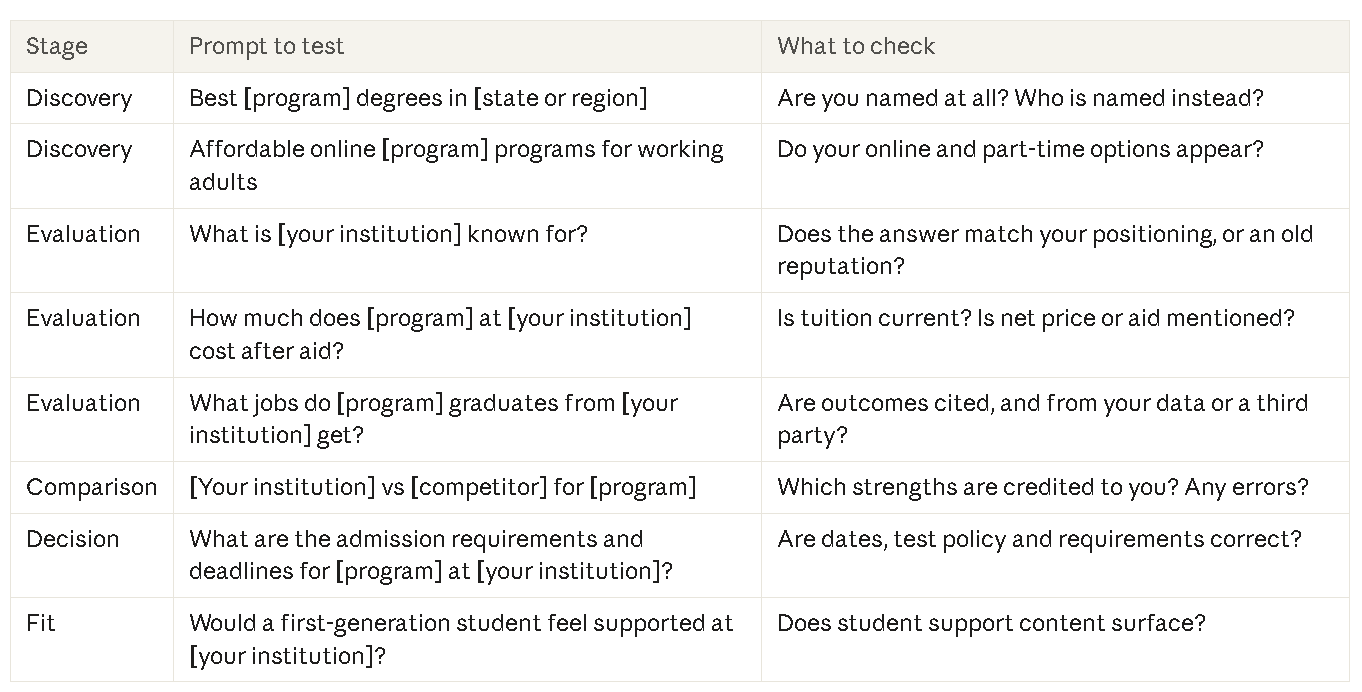
Record each answer in a shared sheet with four columns: mentioned (yes/no), accurate (yes/no), sources cited, and the fix it implies. Rerun the same prompts monthly. AI answers shift as models update and new content gets indexed, so this works best as a standing function, not a one-time project.
Seven fixes that make your institution AI-ready
AI tools can only repeat what they can find and parse. These fixes target the pages that carry the most enrollment weight.
- Put the facts on the program page, in plain text. Cost, length, format, start dates, credits, admission requirements and outcomes belong on every program page. Facts buried in PDFs, images or accordions behind JavaScript are easy for AI to miss.
- Answer the question in the first sentence. Lead each section with the direct answer, then the detail. "The online MSN takes 24 months part-time" is quotable; a paragraph about your nursing heritage is not.
- Publish outcomes with numbers and dates. Median salary, placement rate, top employers, licensure pass rates, each labeled with a year and source. Students ask AI about salaries constantly; if you don't publish the number, a third-party site will.
- Build FAQ blocks from real student questions. Pull questions from admissions inboxes, chat logs and counselor notes. Mark them up with FAQPage schema, and add Course, EducationalOccupationalProgram and Organization schema where they fit.
- Fix contradictions across your web estate. Old catalog pages, outdated department sites and stale third-party listings (Niche, U.S. News, Wikipedia, Google Business Profile) can override your current pages. Retire or redirect old content and update the listings you control.
- Earn mentions beyond your own domain. AI weighs what others say about you. Faculty expertise in the press, rankings, employer partnerships and student stories on credible sites all strengthen how often and how well you're cited.
- Keep the website ready for the student who arrives to verify. AI-referred visitors come late in their decision, looking to confirm one fact. Make cost, deadlines and "apply" reachable in one or two clicks from any program page, with a short inquiry form that does not ask for more than you need.
How to measure AI search impact on enrollment
AI influence is partly invisible to standard analytics, so measure it from several angles and tie each back to your CRM.
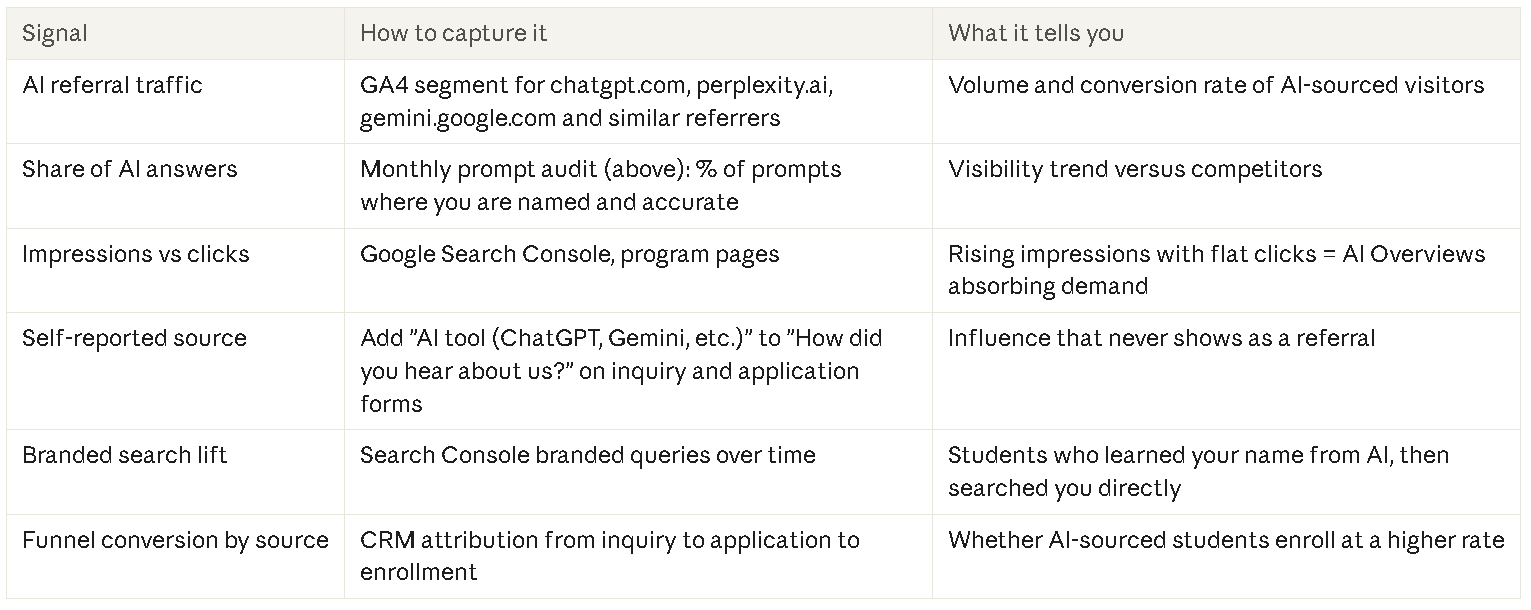
The last row is the one leadership cares about. AI-referred students often arrive later in their decision, so watch for higher inquiry-to-application rates even when volume is modest. Closed-loop reporting that connects web data to your CRM is what turns this from a hunch into a budget case.
Add AI search; don't abandon what works
AI is a new layer on the student journey, not a replacement for it. OHO found roughly one in four students ages 17 to 22 don't use AI chatbots at all, and many more choose not to use them for college search. Those students still rely on Google, your website, counselors and peers.
The winning approach runs both strategies in parallel. Keep investing in search, paid media and a website that tells your story with warmth. Then make sure the facts behind that story are structured, consistent and easy for AI to cite.
Want to know what AI is telling students about you? RAD Higher Ed will run the audit above for your top three programs and send you a short report: where you appear, what's wrong or missing, and the first fixes to make. Request your AI Visibility Snapshot, or learn more about our SEO and AI Search services.
Frequently asked questions
What is answer engine optimization (AEO) for higher education? AEO is the practice of making your institution's content easy for AI tools like ChatGPT, Gemini and Google AI Overviews to find, understand and cite. For colleges, it focuses on program pages, cost, admissions and outcomes content.
How many prospective students use AI to research colleges? EAB's survey of more than 5,000 high school students found 46% used AI tools in their college search in fall 2025, up from 26% in spring 2025.
Does AI search replace traditional SEO for colleges? No. AI tools draw heavily on well-structured, well-ranked web content, so technical SEO and strong program pages remain the foundation. AEO builds on that foundation.
How can a college see what ChatGPT says about it? Ask the questions prospective students ask, in a fresh session, across several AI tools. Record whether you're mentioned, whether the facts are correct and which sources are cited, then repeat monthly.
How do you track enrollment from AI search? Combine AI referral traffic in GA4, a self-reported "AI tool" option on inquiry forms, branded search trends and CRM attribution from inquiry through enrollment.
Sources
EAB: Nearly Half of High School Students Now Use AI in College Search (Feb 2026)
OHO: Four in Ten Students Already Ask AI About Colleges (Apr 2026)
Search Engine Land: Google zero-click searches hit 68% in early 2026
PPC Land: Ahrefs finds AI Overviews cut top-result CTR 58%
Relevant Audience: AI Overview impact on organic search, 2026